Cart
Your shopping cart is empty!
It's never too late to make things right :)


Press service of "Tyzhnevyka APTEKA" No. 41 (862) October 22, 2012
No matter how many discoveries we make, nature never ceases to amaze us, giving us new and interesting discoveries. For example, to the long-known properties of lactulose as a means capable of binding toxins and positively influencing the body's resistance, being a mild laxative and acting as a prebiotic, another one has been added. Researchers have found out: lactulose promotes the absorption of calcium and magnesium in the body, thanks to which everyone who is concerned about the problem of reducing bone density, especially women with osteoporosis, has additional benefits from its use.
And thanks to products such as LACTUSAN and PRELAXAN from the company "Yunatis", this becomes even easier and more pleasant.
A semi-synthetic disaccharide that does not occur in nature, but is obtained by processing milk, - lactulose - has long been known for its prebiotic and laxative properties. Due to the fact that lactulose is practically not digested in the body, but is an excellent nutrient medium for bifidobacteria, its prebiotic properties are revealed. In parallel, many harmful microorganisms, for example, such as clostridia (including Clostridium perfinges and Bacteroidaceae), occur naturally, which means that the ratio of bifidobacteria to the total number of bacteria increases significantly.
These properties provide lactulose with the properties of an osmotic laxative. On the one hand, being in the intestine in an undigested form, it increases the osmotic pressure and causes the transition of water into the intestinal lumen, leading to liquefaction and an increase in the volume of feces. On the other hand, decomposing under the action of intestinal bifidobacteria to short-chain fatty acids, lactulose provides a decrease in the pH of the intestinal environment, leading to an increase in the volume of the contents and stimulation of peristalsis. This ensures the laxative property of this semi-synthetic disaccharide. At the same time, lactulose is not addictive, like many other laxatives, and its use, even long-term, does not cause many toxic effects that arise from the use of laxatives, such as, for example, derivatives of anthraglycosides, which have genotoxic, mutagenic, carcinogenic effects (Hietala P. et al., 1987; Patel PM et al., 2012; Hallmann F., 2000).
In addition, lactulose helps bind the body's waste products and toxins secreted by microorganisms living in the intestines. It is no secret that along with the absorption of water in the large intestine, toxic metabolites are also absorbed. Ammonia, skatole, indole and many others are produced by putrefactive bacteria and, when absorbed, can enter the bloodstream, leading to intoxication and organ damage. The liver suffers from this, as well as the nervous system, whose disorders under the influence of all these toxins can progress from mild mental illnesses to coma. Lactulose allows you to bind ammonia and many other toxins, and therefore prevent negative consequences.
Finally, we have come to the main property that we would like to talk about today - the effect of this semi-synthetic disaccharide on the absorption of calcium and magnesium, thanks to which it helps strengthen bones. The fact is that the ratio of calcium and magnesium is one of the main factors that allow maintaining the strength of bone tissue. After all, when the level of magnesium in the blood decreases, the kidneys restore balance, retaining less calcium; when the concentration of magnesium increases, the kidneys, in turn, excrete less calcium. That is why it is important to maintain this balance, as well as to establish a sufficient supply of calcium to the body. This is especially important for women in the postmenopausal period, when they are most susceptible to calcium loss and the development of osteoporosis as a result. This is also important because with age, more and more women face such a problem as constipation (Drossman DA, Li Z., Andruzzi E. et al., 1993; Everhart JE, Go VL, Johannes RS, et al., 1989). As a result, they uncontrollably begin to use laxatives, which leads to addiction, a decrease in their effectiveness and/or the need to increase the dose each time. Against the background of taking these drugs, important macro- and microelements are excreted, including calcium. This means that the use of laxatives by women over the age of 45, who are already prone to calcium loss, can further aggravate the condition. This problem cannot be solved by simply increasing calcium intake: its bioavailability is low, and even when using dietary calcium in large quantities, the body absorbs and retains a very small amount, which is insufficient to maintain bone density.
It would seem that it is an insurmountable task to help a woman solve the listed age-related problems - to eliminate constipation, normalize the functioning of the digestive tract, and at the same time ensure the intake of a sufficient amount of calcium into the body. However, nothing is impossible with lactulose - it copes with two problems at once. We talked about how it allows you to eliminate constipation a little higher. Therefore, now we will dwell in more detail on its ability to influence the digestibility of calcium and magnesium.
This property of lactulose was discovered in the late 80s of the twentieth century. by a number of Japanese researchers, and then it was studied in more detail (Brommage R., Binacua C., Antille S., Carrié AL, 1993; van Den Heuvel E., Muijs T., Van Dokkum W., Schaafsma G., 1999; van Heuvel E., Muijs Th., van Dokkum W., Schaafsma G., 2002). Researchers have found that the ability of lactulose to affect the absorption of calcium and magnesium is realized in several ways. Many of them are still being studied. One of the proposed mechanisms is that due to the microflora that breaks down lactulose to short-chain fatty acids, a low pH level is formed. This has a positive effect on the solubility of calcium and its absorption from the distal intestine (Younes H., Demign C., Remesy C., 1966).
Prelaksan thanks to this lactulose provides new opportunities - it not only serves as a mild laxative, a prebiotic, allows you to increase the body's resistance to toxins, but also helps to fill the deficiency of calcium and magnesium in the body. This is especially important in the case of women with osteoporosis, as well as in the restoration of bone tissue after fractures.
It should be noted that the stimulating effect of lactulose on calcium absorption is manifested when they are used simultaneously. This means that it must be taken during meals or together with calcium supplements. Otherwise, if the use of lactulose is interrupted, the stimulation of calcium intake into the body also stops. Therefore, everyone who is concerned about insufficient bone density, who has been diagnosed with osteoporosis, and who would like to prevent insufficient calcium intake into the body along with the prevention of constipation, is recommended to use dietary products LACTUSAN and PRELAXAN containing lactulose during meals.
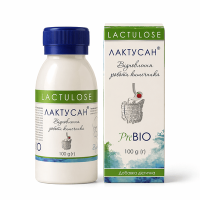
Today, they are presented in a wide range of different forms. Thus, LACTUSAN is available in the form of syrup of 100 and 300 g, and PRELAXAN - in the form of syrup of 220, 400 and 900 g, as well as in the form of powder in sticks of 10 g No. 10. Each of these products contains a high amount of lactulose (not less than 36% and 50%, respectively) and only a small amount of residual sugars, due to which they are absolutely safe for diabetics. And, of course, they are all devoid of many of the disadvantages inherent in most laxatives.


-200x200.jpg)