Cart
Your shopping cart is empty!
It's never too late to make things right :)



Research Objective
1. In in vitro experiments, to study the effect of the drug Lactusan on the growth of bifidobacteria (production strain Bifidum I).
2. In a model of ampicillin- and tetracycline-induced dysbacteriosis in mice, to study the effect of Lactusan on:
- The content of bifido- and lactobacteria;
- Morphology of the colonic mucosa;
- Morphological state of the liver.
MATERIALS AND METHODS
The work used:
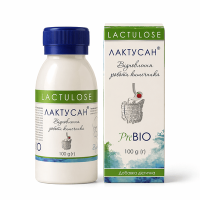
1. Lactusan syrup, containing 40% lactulose, 16% other carbohydrates (12% lactose and 4% galactose) and 1% ash;
2. bifidobacteria of the production strain Bifidobacterium bifidum l (the drug Bifidum-bacterin produced by Ferment LLC);
3. antibiotics - ampicillin sodium salt, tetracycline;
4. mice of the Fl line (CBA/lac x BL/6) weighing 20 g;
5. biological material (liver, intestines, feces, blood) from mice.
In bacteriological studies in vitro, Lactusan was used in the form of 2.5%-0.000025% solutions (lactulose concentrations of 10-0.1 μg/ml, respectively) in a semi-liquid Blaurocca medium or an isotonic 0.9% sodium chloride solution. Bifidumbacterin was dissolved in a liquid Blaurocca medium at the rate of 1 ml per 1 dose of the drug and 0.5 ml of the resulting microbial suspension was added to a number of test tubes containing Lactusan at the indicated concentrations in the same medium. The control samples were introduced a similar amount of bifidobacteria among Blaurocca without Lactusan. Control and experimental samples were incubated in an anaerobatic chamber for 48-72 hours at a temperature of 37°C, after which the culture grown in Blaurock's semi-liquid medium was titrated using the standard method.
Control smears were made on glass from different dilutions of bifidobacteria before sowing and microscopically examined with methylene blue staining. After incubation, smears from 50 crops were reviewed, in which the growth of the culture was visually recorded.
In vitro experiments to study the effect of Lactusan on the microflora and intestinal mucosa, as well as the condition of the liver were carried out on 100 Fl (CBA/C57BL6) mice weighing 18-20 g.
The model of drug pathology was reproduced by intragastric administration of ampicillin at doses of 350-700 mg/kg or tetracycline at a dose of 750 mg/kg daily for 7 days.
Lactusan was administered intragastrically, in the form of a 20-0.15% solution of 0.25 ml of physiological 0.9% sodium chloride solution, with lactulose doses of 1000-7.5 mg/kg, respectively.
The course of simultaneous use of Lactusan with an antibiotic was 7 days. In a separate series of experiments, Lactusan was administered for 14 days (7 days against the background of tetracycline and for the next 7 days).
The material for the study was taken 24 hours after the last administration of the test drug, immediately after the animals were killed by decapitation.
Segments of the proximal colon and pieces of liver taken from the animals were fixed in 10% neutral formalin solution and embedded in paraffin.
Histological studies were performed on 5-μm thick sections stained with hematoxylin-eosin, Alcian blue, Ehrlich's hematoxylin and eosin, and Van Gieson's pyrofuchsin.
Lysozyme activity in blood serum was determined by the microbiological plate method (Kagramanova K. A., Yermolyeva Z. B. 1964).
RESEARCH RESULTS
Study of the effect of Lactusan on bifido- and lactobacteria in vitro
Lactusan solutions with lactulose concentrations of 100-10 μg/ml had a pronounced bifidogenic effect, increasing the content of bifidobacteria by 5-6 lg compared to the control. When using Lactusan solutions with lactulose concentrations of 1-0.1 μg/ml, an increase in the number of bifidobacteria by 3-4 lg was observed. The presence of lactulose in concentrations of 10 mg/ml and higher among bifidobacteria cultivation led to pronounced gas formation.
Thus, the bifidogenic effect of lactulose in Lactusan syrup is maximally expressed at its concentrations of 100-10 μg/ml.
Study of the effect of Lactusan on the macroorganism and its microflora
To study the effects of Lactusan in vitro, we used two experimental models of drug pathology caused by oral administration of large doses of ampicillin and tetracycline. This is due to the fact that both antibiotics are found in high concentrations in bile, tetracycline is excreted in significant quantities (20-50%) with feces. In this regard, the main manifestations of the side effects of these antibiotics on the body include digestive tract dysfunction and dysbacteriosis, and tetracycline, when used in high doses, can have a hepatotoxic effect.
A. Bifidogenic effects of Lactusan in vivo
In model experiments on animals administered antibiotics, the dependence of the bifidogenic effect of Lactusan on its dose was clearly traced.
Ampicillin-induced dysbiosis.
Ampicillin at a dose of 350 mg/kg after 7 days of oral administration did not significantly affect the content of bifidobacteria in the digestive tract of mice, which remained at the level of the intact control (10 9 CFU/g). No inhibition of intestinal bifidoflora was detected even after administration of ampicillin for another 4 days against the background of starvation. When used simultaneously with ampicillin, lactulose in the composition of Lactusan had a pronounced bifidogenic effect in a very wide dose range - from 7.5 to 1000 mg/kg. The optimal increase in the content of bifidobacteria (up to 10 13 CFU/g, i.e. 4-6 lg higher than in intact animals) was achieved when lactulose was used in doses from 7.5 to 125 mg/kg.
Lactulose at doses of 250-1000 mg/kg provided less pronounced stimulation of bifidobacteria growth, but their level remained 2-3 lg higher than the control. However, in mice receiving 1000 mg/kg of lactulose, the appearance of liquid stools was noted.
Ampicillin caused inhibition of lactobacilli growth, as evidenced by a decrease in their content by 2 orders of magnitude (to 10 4-5 CFU/g compared to 10 6-7 CFU/g in intact animals).
Stimulation of lactobacilli growth by Lactusan in this experimental model was detected at all tested doses. Its use in all cases prevented the ampicillin-induced decrease in the level of lactobacteria, and at doses of lactulose 7.5-125 mg/kg their content exceeded the level in mice receiving only the antibiotic by 3-4 lg, and was 2 lg higher than in the control.
Tetracycline-induced dysbiosis.
Tetracycline at a dose of 750 mg/kg after a 7-day course of its use caused a decrease in the content of bifidobacteria in the feces of mice by 2 lg compared to the intact control.
The simultaneous administration of lactulose at doses of 125-62.5 mg/kg with tetracycline not only prevented the suppression of bifidobacteria, but also provided an increase in the level by 2-3 lg. It is important to note that in this experimental model, the optimal bifidogenic effect (an increase in the level of bifidobacteria by 4 lg compared to the control) was observed in the group of animals that received lactulose at a dose of 125 mg/kg for 14 days (7 days on the background of tetracycline and 7 days after its withdrawal). This scheme of using Lactusan also provided an increase in the level of lactobacteria by at least 2 lg compared to the intact control. In mice of this group, a moderate increase in the content of lysozyme in the blood serum of mice was also noted - up to 4 μg/ml compared to 2.0-2.6 μg/ml in the control and in mice that received only tetracycline.
The use of a 1.25% solution of Lactusan, i.e. lactulose at a dose of 62.5 mg/kg, instead of tetracycline ensured the preservation of the initial level of lactobacteria in the feces of mice.
B. Morphological studies.
1. Study of the intestinal mucosa
Ampicillin model
Ampicillin at a dose of 350 mg/kg intragastrically for 7 days induced the development in the small intestine of a morphological picture of moderate toxic enteritis, which was characterized by dystrophy of the surface epithelium of intestinal villi along their entire length, lymphostasis and edema. In the large intestine, the phenomena of minimal toxic colitis were noted: dystrophy of surface epithelial cells, vascularization of the subepithelial sections of the stroma and its edema.
The use of Lactusan at the optimal dose of lactulose 125 mg/kg simultaneously with ampicillin effectively protected the intestinal mucosa, ensuring complete normalization of its morphology and cellular composition.
Tetracycline model
Under the influence of tetracycline, morphological signs of toxic enteritis were observed in the mucosa of the small intestine; pronounced vacuolar dystrophy of villous epithelial cells; a large number of interepithelial lymphocytes (IEL) in the superficial epithelium of the intestinal mucosa; few goblet cells were found in the villous epithelium and they were weakly stained with Alcian blue, which indicates their weak functional activity.
It is important to note the degranulation of Paneth cells, which are the main producers of endogenous lysozyme and secretory immunoglobulins in the mammalian intestine, detected under the influence of the antibiotic.
In the colon of mice treated with tetracycline, a typical morphological picture of toxic colitis developed. In one mouse, a crypt abscess was histologically detected, dystrophic changes in epithelial cells were observed in all animals, the number of interepithelial lymphocytes and goblet cells, weakly stained with Alcian blue, increased in the surface epithelium.
Lactusan, when used for 14 days (7 days against the background of the antibiotic and 7 days after its withdrawal) at 0.25 ml of a 2.5% solution, which corresponds to a dose of lactulose 125 mg/kg, effectively prevented the development of these changes and ensured complete normalization of the morphology of the thin and thick mucous membranes.
2. Liver condition study
The protective effect of lactulose in the composition of Lactusan on liver tissue was revealed, which was most clearly manifested in tetracycline-induced drug damage.
Tetracycline model
Under the influence of tetracycline, we observed typical manifestations of acute toxic drug hepatitis with pronounced fibrosis of most portal tracts. In the liver lobules, damage was noted mainly of centrilobular and periportal hepatocytes.
Optimal protection of liver tissue from the damaging effects of tetracycline was provided by lactulose at a dose of 125 mg/kg, which was administered for 7 days against the background of the antibiotic and 7 days after its withdrawal. In animals of this group, the morphological picture of liver tissue did not differ from that of intact animals.
When lactulose was administered at a dose of 62.5 mg/kg for 7 days against the background of tetracycline, no typical phenomena of acute toxic hepatitis for the action of the antibiotic were observed. Fatty hepatosis of varying severity with moderate fibrosis of most portal tracts was detected.
Thus, in our chosen model of tetracycline-induced toxic hepatitis, a significant protective effect of Lactusan on liver tissue is manifested only at a dose of lactulose corresponding to 125 mg/kg.
Ampicillin model
Unlike tetracycline, ampicillin did not cause significant damage to the tissue and cellular composition of the liver of mice. Its histological structure in mice treated with ampicillin differed little from that in intact animals. Only moderate fibrosis of individual portal tracts was noted.
In most animals treated with ampicillin and lactulose in doses from 31.25 to 125 mg/kg, the morphological picture of the liver tissue was close to that in the control. A slight increase in the lumen of the central veins and hepatic veins of the portal tracts was observed. In a number of cases, minimal fatty hepatosis was detected against the background of mild or moderate fibrosis of individual portal tracts. When using a 5% solution of Lactusan (dose of lactulose 250 mg/kg), the phenomena of fibrosis were more pronounced.
The best protective effect of lactulose in the composition of Lactusan was provided by a dose of 125 mg/kg, i.e. 300 mg/kg of Lactusan.
CONCLUSIONS
1. Lactulose concentrate Lactusan has a pronounced bifidogenic effect, stimulating the growth of bifidobacteria in vitro and in vivo.
2. The bifidogenic effect of Lactusan is manifested in a wide range of doses. The optimal bifidogenic effect in vitro is provided by 0.025% and 0.0025% solutions of Lactusan, which correspond to lactulose concentrations of 100 and 10 μg ml. Pronounced stimulation of bifido- and lactoflora in mice on a model of dysbiosis induced by ampicillin or tetracycline is manifested by the use of Lactusan at 0.25 ml of 2.5-0.15% solutions, which corresponds to lactulose doses of 125-7.5 mg/kg.
3. Lactusan has a dose-dependent protective effect on liver tissue and intestinal mucosa, preventing the side toxic effects of high doses of tetracycline and ampicillin. Lactusan in the form of a 2.5% solution (lactulose dose 125 mg/kg) showed a pronounced protective effect on liver tissue, mucous membrane of the small and large intestine when used simultaneously with high doses of ampicillin and tetracycline.
4. The maximum effect of Lactusan was obtained when lactulose was administered at a dose of 125 mg/kg for 14 days (7 days on the background of tetracycline and 7 days after discontinuation of the antibiotic). The use of Lactusan according to this scheme provided the greatest increase in the content of bifido- and lactobacteria, completely prevented the development of tetracycline-induced toxic lesions of the liver and intestinal mucosa.
5. The prospects and feasibility of continuing the experimental study of the properties of Lactusan and the mechanisms of their implementation, the search for ways to enhance its probiotic and hepatoprotective effects in order to develop optimal conditions for its use in medical practice for the prevention and treatment of alcoholic, drug-induced and other lesions of the digestive tract have been revealed.
-200x200.jpg)