Cart
Your shopping cart is empty!
It's never too late to make things right :)



(Department of Pediatrics, Children's City Clinical Hospital).
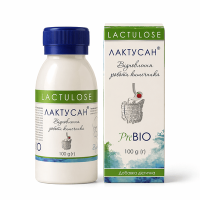
Previously conducted tests of the Lactulose concentrate "Lactusan" (syrup consisting of 70% of dry matter from lactulose, produced by LLC "Yunatis") at the department showed that this biologically active food additive can be used for intestinal dysfunction and dysbacteriosis, often concomitant.
To create a healthy and functional diet enriched with bifidus factors, it is advisable to base it on traditional food products. As such, kefir was chosen, which satisfies not only with good taste, but is also known as a means of improving intestinal function.
The purpose of the tests was to compare the effectiveness of ordinary kefir, produced using traditional technology, without any additives, and kefir with the addition of lactulose "Lactusan" (OST 49 29-84 "Kefir", amendment No. 7 to OST 49 29-84).
The tests were conducted with two groups of children, one of which is considered a control (receives kefir without additives), and the other as an experimental (receives kefir with the addition of 0.5% by weight of lactulose syrup "Lactusan"). The mixture of kefir with "Lactusan" was prepared at VNIMI using the following technology: first, kefir was prepared using the appropriate technology, then "Lactusan" syrup was added. The homogeneous mixture was poured into molds with a capacity of 200 ml and hermetically sealed with aluminum foil. Control samples were prepared in the same way, only without the addition of lactulose.
Each child received one package of the product daily. Thus, the daily dose was 200 g, and the course of the study lasted 20 days. Before and after the course, a bacteriological analysis of feces was performed.
Children aged 1 to 15 years were selected for the test, mainly with intestinal dysfunction, expressed in the form of constipation or irregularity of the stool with mucus, with pain in the abdomen. In some cases, children also had diseases such as atopic dermatitis, infectious and others. The treatment was carried out on an outpatient basis, but the patients were under the constant supervision of doctors.
This report presents the results of the study of 30 children who, in addition to clinical observation, have data on the analysis of dysbacteriosis before and after taking: 10 in the control and 20 who received kefir with lactulose "Lactusan". To evaluate the results, clinical data obtained by direct observation of patients at the doctor, as well as by interviewing the parents of sick children and data from bacteriological analysis were used. Bacteriological analysis was performed in the hospital laboratory using the state-approved methodology.
According to the standard, the norm for children over 1 year old is the following indicators (abbreviations used in the corresponding table are entered in brackets): bifidobacteria (B) - 108 and more, lactobacteria (L) - 106-108, Escherichia (ES) - 107-108, of which lactobacilli 2%, enterococci (EN) - 105-106, Klebsiella (Cl) - <104, staphylococci (ST) - <104, yeast-like fungi (DG) - <103. The table includes data that differ from the given values or show dynamics, as in the case of lactobacteria.
The stool is characterized by the following terms: “norm” – regular stool, normal consistency, “sheep feces” – a manifestation of constipation.
To characterize the fecal microflora, measurements were made according to the 12 indicators listed above. Data were entered for those indicators that go beyond the above norms or that undergo changes due to kefir intake. Those bacteranalysis indicators that fall within the norm are not included in the table. The designation “percentage (3)” is used when there is no microbial culture when diluted for lg KOE = 3.
In the control group of 10 children, 7 (70%) had impaired intestinal function in the form of constipation. Of these, one had stool with mucus. After a course of kefir (without lactulose), the stool was completely normalized in 5 children and partially in 2 children. Bacterial analyses of feces showed a reduced level of bifidobacteria (up to log KOE = 7) and lactobacteria (up to 5-6) in four children. After taking kefir, the level of bifidobacteria increased in two children. The level of lactobacteria increased in two, but sharply decreased in four children. Other changes in the composition of the microflora in the control group were rare and insignificant.
In the second group, where kefir was taken with a 0.5% lactulose supplement "Lactusan", there were 20 children aged 1 to 12 years. In 9 children (47%) in the experimental group, the level of bifidoflora after a course of kefir with lactulose "Lactusan" increased, but in three children (15%), who had viral and other diseases during the intake, it decreased by 1 log unit. An increase in the level of lactobacteria was observed in 13 children (65%), and three (15%) observed a slight decrease. Against the background of taking kefir with lactulose, there was a noticeable cleansing of the intestines from conditionally pathogenic flora (hemolytic, weakly fermenting and other forms, as well as Proteus, Klebsiella, staphylococci and others).
G.V., 1 year old, had dysbacteriosis of the 2nd degree and with low levels of lacto- and bifidobacteria, had a noticeably high level of Klebsiella (lg KOE = 6). This child was treated with phage, but there was no improvement. A course of treatment with kefir with "Lactusan" led to the disappearance of Klebsiella and an increase in the number of bifido- and lactoflora. Significant improvements were seen in the clinic, when intestinal dysfunction disappeared and bowel movements normalized. In two other cases, when children had a reduced level of bifido- and lactoflora before treatment (K.K., 7 years old and Ch.M., 7 years old), complete normalization of microflora was achieved, and the tendency to constipation disappeared and bowel movements normalized.
In some cases, the effect of kefir was insufficient and an additional course of kefir with lactulose “Lactusan” was required. In child K.K., 7 years old, kefir helped eliminate constipation, however, its influence on the entire composition of microflora was quite effective, since lactobacteria remained at a very low level. After a course of kefir with lactulose, the level of lactoflora increased from < 5 to 6. In another child (M.E., 3.5 years old), a course of kefir led to the occurrence of constipation, and this child was transferred to the experimental group, which received kefir with lactulose “Lactusan”. Normalization of bowel movements and improvement of the composition of microflora have been achieved.
If in the control group the increase in the level of bifidobacteria was only in 20% of children, then in the experimental group that took kefir with lactulose – 47%. In the change in the level of lactobacteria, the difference is even greater – 20% versus 65%, respectively. Regular kefir caused a decrease in lactobacteria in 50% of children, which sometimes exceeded 100-fold, kefir with lactulose - only in 1 person (5%). At the same time, the stool in the experimental group normalized in all (100%) children.
General conclusion on clinical studies of kefir with lactulose, produced according to OST 49 29-84, amendment No. 7:
Conclusion: kefir enriched with lactulose "Lactusan" according to OST 49 29-84, amendment No. 7, has a more favorable effect on the intestinal microflora than regular kefir.
We recommend kefir with lactulose (OST 49 29-84, amendment No. 7) as a mass product for the prevention of gastrointestinal diseases, including dysbacteriosis and intestinal dysfunction.
From the Department of Pediatrics:
Head of the Department, Doctor of Medical Sciences,
Professor L. T. Kuzmenko
Assistant, Candidate of Medical Sciences N. I. Petruk
From the Department of Urology and Operative Nephrology of the PFUR:
Head of the Department, Doctor of Medical Sciences,
Professor, Academician of the Ukrainian Academy of Higher Education V. E. Rodoman
Chief Researcher Doctor of Biological Sciences V. I. Maksimov
Scientific Secretary of the Academic Council, Candidate of Chemical Sciences A. P. Kropyvka